

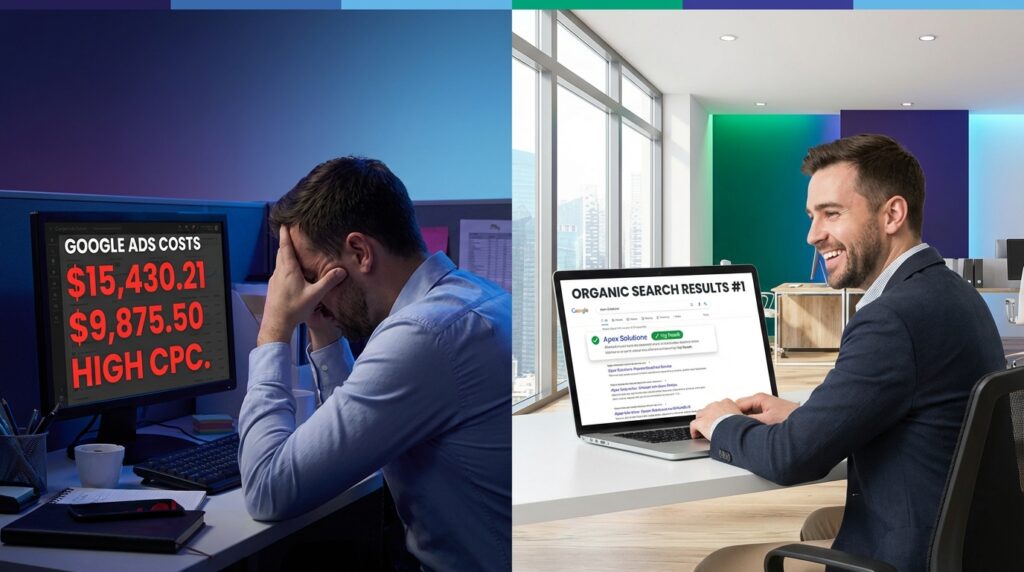

Let’s be honest about something most marketing agencies won’t tell you.
Google Ads work. But they’re expensive, they’re getting more expensive every year, and the moment you stop paying — the traffic stops completely. You haven’t built anything. You’ve been renting attention, not owning it.
Meanwhile, businesses that invested in organic SEO three years ago are now getting hundreds of qualified visitors every day without paying for a single click. Their competitors are wondering how they do it. The answer is simple: they built something instead of renting it.
This guide will show you exactly how organic search works, why it outperforms paid ads for most small businesses in the long run, and what you need to do to start getting customers from Google — without paying for every one of them.
Why Most Small Businesses Are Wasting Money on Google Ads
Here’s a number that should make you pause: the average cost-per-click for Google Ads in competitive service industries — plumbing, legal, healthcare, real estate — ranges from $15 to $80 per click. Not per customer. Per click. Most of those clicks don’t convert.
If you’re running Google Ads and converting at a typical 3–5% rate, you’re paying $300 to $2,600 for every customer who contacts you. That math gets uncomfortable quickly — especially when organic SEO can deliver the same customers for a fraction of that cost once it’s established.
The real problem isn’t that paid ads don’t work. It’s that most small businesses use them as a permanent strategy instead of a short-term bridge — and they never build the organic foundation that would make them less dependent on ad spend over time.
The Compounding Problem With Paid-Only Marketing
- Ad costs increase every year. More businesses competing on the same keywords drives prices up consistently. What cost $15/click in 2022 costs $25 in 2025.
- Traffic stops instantly when the budget stops. There’s no residual value. No momentum. Every month you’re starting from zero.
- You’re competing at a disadvantage. Large competitors with bigger budgets can simply outspend you into irrelevance.
- Customers trust organic results more. Studies consistently show that over 70% of searchers skip the paid ads and click organic results instead — especially when they’re researching rather than ready to buy immediately.
How Organic SEO Works — And Why It’s Different
Organic SEO is the process of making your website show up higher in Google’s non-paid search results for the specific terms your customers type when they’re looking for what you offer.
When someone in your city searches “plumber near me” or “best SEO agency for small business” or “organic supplements online” — Google shows them a ranked list of websites it believes are the most relevant, trustworthy, and helpful for that query. Getting into that list — and as high as possible on it — is what SEO does.
The critical difference from paid ads: once you’ve earned a position in those organic results, you keep getting traffic from it without paying per click. The work you do today is still delivering customers in month six, month twelve, year three.
What Google Actually Looks For
Google’s algorithm evaluates hundreds of factors, but most of them come down to three things:
- Relevance — Does your page clearly address what the searcher is looking for? This is determined by your content, keywords, and how well your page matches the searcher’s intent.
- Authority — Does the web trust your website? This is largely determined by the quality and quantity of other websites linking to yours (backlinks) and your overall domain reputation.
- Technical Quality — Can Google properly access, crawl, and index your website? Is it fast? Is it mobile-friendly? Does it pass Core Web Vitals tests?
All of organic SEO is essentially the practice of improving these three factors — systematically, over time, without taking shortcuts that Google will eventually penalise.
The 5 Things Your Business Needs to Start Getting Customers From Google Organically
1. A Website That Google Can Actually Read
This sounds obvious, but most small business websites have technical issues that prevent Google from properly understanding and ranking their content. Slow page speed. Missing meta tags. Pages that aren’t indexed. Poor mobile experience. JavaScript that hides content from search engine crawlers.
Before any other SEO work is done, your website needs a solid technical foundation. Google cannot rank a page it cannot properly access and understand. A technical SEO audit typically reveals 20 to 50 issues on the average small business website — most of which the owner never knew existed.
2. Pages That Target the Right Keywords
Keyword research is the process of finding the specific phrases your potential customers type into Google when they’re looking for what you offer — and then creating pages on your website that are explicitly built around those phrases.
The most valuable keywords for any local or service business usually follow a simple pattern: service + location + intent. “Emergency plumber Denver.” “Brand identity designer for small business.” “Organic supplement store near me.” These are high-intent searches — people typing them are already looking for a solution.
Each important keyword cluster should have its own dedicated, properly optimised page on your website. A single homepage trying to rank for everything ranks for nothing.
3. Content That Actually Helps People
Google’s algorithm has become increasingly sophisticated at distinguishing genuinely helpful content from content that’s simply trying to rank. The businesses winning at organic search in 2025 are the ones creating content that genuinely answers the questions their potential customers are searching for.
That means blog posts that teach something real. Service pages that explain what you do and why it matters without fluff. FAQs that answer the actual questions people ask. Location pages that are genuinely useful to someone looking for a service in that area.
Content is the long-term fuel of organic growth. Every genuinely helpful piece of content you publish is a new entry point for customers searching Google — and unlike a paid ad, it keeps working indefinitely.
4. Backlinks From Relevant, Trusted Sources
Backlinks — other websites linking to yours — remain one of Google’s strongest ranking signals. They function as votes of trust: when a relevant, reputable website links to your business, it signals to Google that your site is worth trusting.
Not all backlinks are equal. A single link from a respected industry publication is worth more than hundreds of links from low-quality directories. Building a strong backlink profile takes time, but it’s one of the most durable ranking advantages a business can build — because it’s genuinely hard for competitors to replicate quickly.
5. Consistency — The Most Underrated SEO Factor
SEO is not a one-time project. It’s an ongoing practice. The businesses that dominate organic search in their markets are the ones that show up consistently — publishing content regularly, fixing technical issues as they arise, building authority steadily over time.
This is also where most businesses fail. They invest in SEO for three months, don’t see dramatic results, and stop. Then six months later, they wonder why their competitors are outranking them. The competitors that are winning kept going.
How Long Does It Take to Get Customers From Organic Search?
This is the question every business owner asks — and the honest answer is: it depends. But here’s a realistic framework:
- 0–3 months: Foundation building — technical fixes, keyword research, initial content and on-page optimisation. You may see some early movement for less competitive terms.
- 3–6 months: Early wins — rankings improving for local and long-tail keywords, organic traffic beginning to grow, first enquiries from organic search starting to appear.
- 6–12 months: Meaningful results — consistent organic traffic, reliable lead flow from search, compound growth as your authority builds.
- 12+ months: Significant competitive advantage — strong positions for competitive keywords, organic search becoming a primary lead source, ROI compounding as the work builds on itself.
One of our clients — a plumbing business in Toronto — went from 12 inbound leads per month to 38 per month within 4 months of starting a proper SEO strategy. A Denver organic grocery store grew their local organic traffic by 320% in 6 months. An Australian health supplement brand achieved an Amazon Best Seller badge within 8 weeks of their SEO and brand overhaul.
These aren’t outliers. They’re what happens when the right strategy is executed consistently in a market that isn’t already saturated with strong competitors.
Organic SEO vs Google Ads — The Real Comparison
This isn’t an argument that paid ads are bad. They’re not. For certain situations — launching a new product, running a seasonal promotion, entering a new market quickly — paid ads serve a genuine purpose.
But for most small businesses looking for sustainable growth, organic SEO wins on every metric that matters in the long run:
- Cost per lead decreases over time with SEO (your traffic grows while your costs stay flat). With ads, cost per lead increases as competition grows.
- Traffic doesn’t stop when you’re not spending. Your organic rankings keep delivering while you sleep.
- Trust is higher. Customers trust businesses that appear organically over those that appear as ads.
- You build an asset. Your domain authority and rankings are genuine business assets. Ad spend history is not.
Where to Start — If You’re a Small Business Owner Reading This
The honest place to start is with a proper audit. Before you can improve your organic search performance, you need to understand where you currently stand — what technical issues your site has, what keywords you could realistically target, and how competitive your market is.
At SR Orbit, we offer a free SEO audit and consultation for businesses in the US, Canada, and Australia. We’ll look at your current situation and give you an honest assessment of what it would take to start generating organic traffic and leads in your specific market — without any obligation to continue working with us.
If you’re ready to stop paying for every click and start building something that compounds over time — get in touch and let’s talk.
SR Orbit is a full-service organic marketing agency based in Dhaka, Bangladesh, helping businesses in the US, Canada, and Australia rank higher, get more leads, and grow organically.