

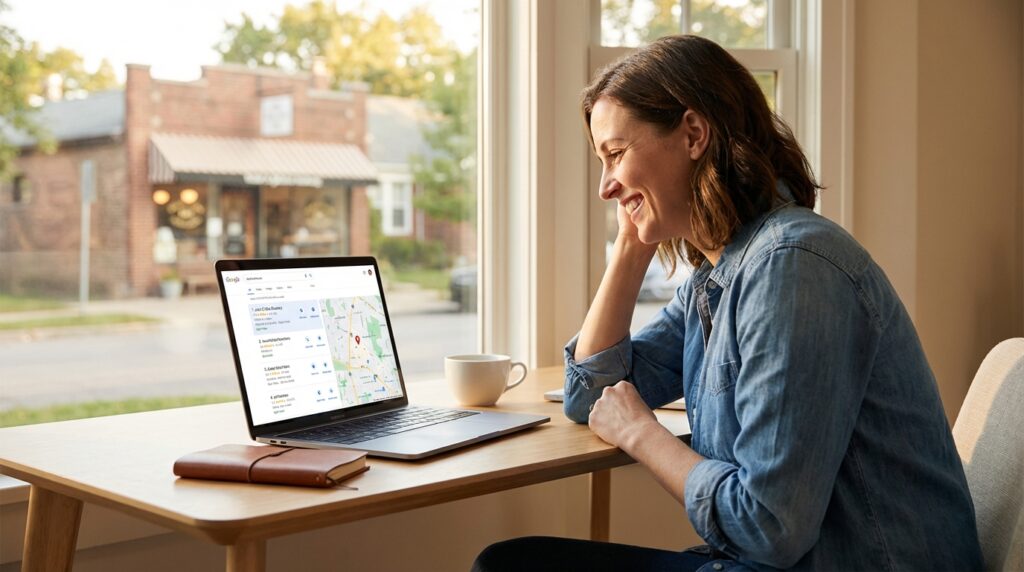

Here’s something that surprises most small business owners when they first hear it.
The plumber, the dentist, or the café that shows up first when you search “near me” on Google — they’re not there because they paid the most. They’re there because someone took the time to build a proper local SEO strategy. And that strategy is doing more for their business every single day than any paid ad campaign could.
Local SEO for small business is one of the highest-ROI investments you can make in 2025 — and most small businesses are barely scratching the surface of what it can do. This guide covers exactly what local SEO is, why it matters more than ever right now, and the seven specific things you need to do to start ranking higher in your city.
What Is Local SEO — And Why Does It Matter for Small Business?
Local SEO is the process of optimising your online presence so that your business appears prominently when people in your area search for the products or services you offer. The primary battleground is Google — specifically, the Google Maps 3-Pack (the three local businesses that appear with a map at the top of local search results) and the organic listings directly below it.
The numbers behind local search are striking. 46% of all Google searches have local intent — meaning nearly half of every search made on Google is someone looking for something in a specific location. And when people do search locally, 78% of local mobile searches result in an offline purchase within 24 hours. Someone searching “plumber near me” at 9pm isn’t browsing. They need a plumber right now.
For small businesses that serve a specific area — whether you’re a service business, a retailer, a restaurant, or a professional — local SEO is the single most direct path from “someone is searching for what I offer” to “that person calls me.” And unlike paid advertising, the results compound over time. Once you’ve earned those rankings, you keep getting traffic without paying for every click.
7 Proven Local SEO Tips for Small Business in 2025
1. Optimise Your Google Business Profile — Completely
Your Google Business Profile (GBP) is the most powerful piece of local SEO real estate available to any small business — and it’s free. It determines whether you show up in the Google Maps 3-Pack, which captures 44% of all clicks for local searches. Most businesses set it up once and forget it. The businesses ranking at the top treat it as an active, managed asset.
Complete optimisation means: choosing the most accurate primary category (this alone has an enormous impact on which searches trigger your listing), filling in every attribute and service detail available, uploading 15+ high-quality photos including your exterior, interior, team, and work, adding your complete service list with descriptions, and publishing a weekly GBP post — even just a brief update keeps your listing fresh and signalling activity to Google.
One stat that always gets attention: businesses with photos receive 42% more requests for directions and 35% more website clicks than those without. Photos aren’t decoration. They’re a ranking and conversion factor.
2. Build a Review Generation System — Not Just Ask Occasionally
Reviews are one of the strongest local ranking signals Google uses — and more importantly, they’re one of the strongest trust signals your potential customers use. In local search results, the business with 150 five-star reviews almost always wins the click over the business with 12 reviews, regardless of which has been around longer.
The mistake most businesses make is treating review generation as something that happens when they remember to ask. The businesses winning at local SEO have a system: a follow-up message that goes out to every customer within 24–48 hours of their service. A QR code in the shop, on the receipt, or on the van. A short, direct link to the Google review page that removes all friction.
Consistency matters more than volume. A business that generates 5–8 new reviews every month will, over time, completely dominate a competitor who collects 50 in a burst and then nothing for six months. Google rewards recency.
3. Target Local Keywords With Buyer Intent — Not Just Generic Terms
Most small businesses make the same keyword mistake: they target broad, generic terms that are nearly impossible to rank for (“plumber,” “SEO agency,” “restaurant”) instead of the specific, local, high-intent terms their actual customers are typing.
The most valuable local keywords follow a simple formula: service + location + intent. “Emergency plumber Denver.” “Best organic café Melbourne.” “Affordable SEO agency Toronto.” These are searches people make when they’re ready to act — not just browsing. And because they’re specific, they’re far more achievable to rank for than their generic equivalents.
Don’t ignore “near me” searches either. Voice search now accounts for over 55% of local queries, and people asking their phone for help say things like “best plumber near me open now” — conversational, specific, and urgent. Your content needs to speak that language naturally.
4. Create Dedicated Pages for Every Service and Location You Serve
One of the most impactful — and most neglected — local SEO tactics for small businesses is creating dedicated pages for each combination of service and location you want to rank for.
Your homepage can’t rank for every service you offer or every neighbourhood you serve. If you’re a plumber covering five suburbs, you need a page for each suburb targeting “[service] + [suburb]” keywords. If you offer five different services, each service needs its own page with unique content, proper keyword targeting, and specific calls to action.
Local keywords with city-level specificity generate 200–300% more conversions than broad terms. The reason is simple: someone searching “plumber Scarborough Toronto” is looking for exactly what you offer, in exactly the area you serve. That’s a warm lead. A generic search is a much colder one.
5. Ensure NAP Consistency Across the Web
NAP stands for Name, Address, Phone number. Google cross-references your business information across dozens of directories, business listings, and data aggregators on the web. If your name appears differently on Yelp than on your website — even a minor variation like “St” vs “Street” — it creates confusion about whether these are the same business, which weakens your local authority.
Audit your business listings on the major platforms: Google Business Profile, Yelp, Facebook, Yellow Pages, Angi, TripAdvisor, Apple Maps, Bing Places. Make sure your NAP is 100% consistent everywhere. Then build citations on platforms specific to your industry and location — local directories, regional business associations, industry-specific listing sites.
Citation consistency isn’t glamorous work, but it’s foundational. And inconsistency is one of the most common issues we find when auditing local business websites — even ones that have been running for years.
6. Make Your Website Fast, Mobile-First, and Technically Sound
Google indexes the mobile version of your website first. If your mobile experience is poor — slow to load, hard to navigate, text too small to read without zooming — your rankings suffer even for people searching on desktop. This isn’t a future concern. Mobile-first indexing has been the standard since 2021.
For local businesses, the stakes are especially high. Nearly 80% of local searches happen on mobile — often in urgent situations. Someone whose pipe is leaking is on their phone. Someone looking for a café nearby is on their phone. Your website has approximately 3 seconds to load and communicate your key information before they go back and click your competitor instead.
A proper local SEO foundation requires: PageSpeed score above 80 on mobile (aim for 90+), Core Web Vitals passing all three thresholds (LCP, INP, CLS), a prominently displayed click-to-call button on every mobile page, and clear, fast access to your address and opening hours. These aren’t optional. They’re table stakes for local search in 2025.
7. Build Local Backlinks — Especially From Community Sources
Backlinks remain one of Google’s strongest ranking signals — and for local search, the relevance of those backlinks matters as much as their quality. A link from a local business association, a regional news site, a community blog, or a complementary local business carries more weight for your local rankings than a generic link from a large national directory.
Practical local link-building strategies include: sponsoring local events or sports teams (which typically include a website mention), being quoted as an expert in local news articles, partnering with complementary businesses for mutual mentions, getting listed on your local chamber of commerce website, and converting unlinked mentions of your business (when local sites mention you without linking) into actual backlinks through simple outreach.
Even a handful of high-quality local backlinks can make a meaningful difference in local rankings — because your competitors likely have very few of them, too.
How Long Does Local SEO Take to Work?
The honest answer: faster than most people expect for local SEO, slower than most people want.
For less competitive local markets — a regional town, a specific neighbourhood in a larger city, or a niche service without many local competitors — meaningful ranking improvements often appear within 60 to 90 days of a properly executed local SEO strategy. Highly competitive markets like major city centres for common services (plumbing, legal, healthcare) take 4 to 6 months for significant movement.
What consistently accelerates results: a fully optimised Google Business Profile from day one, a review generation system that starts producing results within weeks, and fixing existing technical issues that might be preventing Google from properly indexing your pages. These are the quick wins. Authority building — backlinks, content, citations — takes longer but compounds significantly over time.
The Local SEO Checklist for Small Business (Quick Reference)
- ✅ Google Business Profile fully completed and actively managed
- ✅ Review generation system in place — consistent, not occasional
- ✅ Primary keywords: service + location + intent on every key page
- ✅ Dedicated pages for each service and each location served
- ✅ NAP consistent across all directories and platforms
- ✅ Website loads under 2 seconds on mobile — PageSpeed 80+
- ✅ Click-to-call visible on every mobile page
- ✅ Local backlinks from community and industry sources
- ✅ Schema markup for LocalBusiness, Service, and FAQPage
- ✅ Google Search Console set up and monitored
Where SR Orbit Can Help
At SR Orbit, local SEO for small businesses is one of our core specialities. We work with service businesses, retailers, and local brands across the United States, Canada, and Australia — helping them move from invisible on Google to booked out, without spending a dollar on paid ads.
One of our clients — a plumbing business in Toronto — went from 12 inbound leads per month to 38 per month within 4 months of implementing a proper local SEO strategy. A Denver organic grocery store grew local organic traffic by 320% in 6 months. These aren’t exceptional cases. They’re what happens when the right strategy is applied consistently in a market with real demand.
If you’d like an honest assessment of where your local SEO currently stands — and what it would take to move the needle in your market — we offer a free SEO audit for new clients. No obligation, no pressure. Just real information about your real situation.
Get your free local SEO consultation →
SR Orbit is a full-service organic marketing agency based in Dhaka, Bangladesh, specialising in local SEO, web development, and brand identity design for businesses in the US, Canada, and Australia.